A toolbox talk is a short, focused safety conversation held on the jobsite before crews start work. This guide gives you a practical system for running one in 10 to 15 minutes, a simple way to document attendance and sign-offs that satisfies WorkSafeBC and OSHA recordkeeping, and a categorized bank of more than 50 topic ideas you can rotate through the whole year. Use it to plan a full 2026 schedule without staring at a blank page every Monday morning.
What a Toolbox Talk Is and Why Weekly Talks Work
A toolbox talk (sometimes called a tailgate meeting, safety chat, or pre-shift briefing) is a brief, informal safety meeting delivered where the work happens. It is not a classroom lecture. It is a foreman or lead standing with the crew, raising one specific hazard, and agreeing on how to control it that day.
Short and frequent beats long and rare. A crew will remember a sharp 12-minute talk about the trench they are about to enter far better than a two-hour quarterly seminar that covers everything and sticks to nothing. Weekly 10 to 15 minute talks work for a few reasons:
Free Download: 5 Safe Work Procedures
Choose from 112 professionally written SWPs. No credit card required.
Get Free SWPs- Attention holds. People stay engaged for a single topic delivered in a few minutes. Past 15 minutes, retention drops and the meeting starts to feel like a punishment.
- Relevance stays high. A weekly cadence lets you match the topic to real conditions: the heat wave this week, the new subcontractor arriving, the crane pick scheduled Thursday.
- Habits form. A predictable rhythm turns safety into routine rather than a reaction to the last incident.
- It builds a record. Regular, documented talks show a regulator, an insurer, or a client that you run an active safety program, not a binder that gathers dust.
Many jurisdictions expect regular safety communication as part of a health and safety program. WorkSafeBC, for example, expects employers to instruct and supervise workers on safe work practices, and OSHA in the United States requires effective training and communication of hazards under various standards. A weekly toolbox talk is one of the simplest ways to demonstrate you are meeting that expectation. Requirements vary by jurisdiction and by the size of your operation, so confirm current rules for your region.
How to Run an Effective Toolbox Talk
The difference between a talk that changes behavior and one that wastes ten minutes is structure. Use a simple, repeatable format so leads know exactly what to do even when they are tired and behind schedule.
A simple 5-step structure
- Open with the why (1 minute). Name the topic and tie it to today. "We are talking about silica dust because we are cutting concrete on the north slab this morning."
- Explain the hazard (2 to 3 minutes). What can hurt someone, and how badly. Keep it concrete. Real examples from your own sites land harder than statistics.
- Give the controls (3 to 4 minutes). Exactly what the crew will do about it: the wet-cutting method, the respirator, the exclusion zone, who checks what.
- Open the floor (2 to 3 minutes). Ask the crew what they are seeing. This is where the real hazards surface.
- Confirm and sign off (1 to 2 minutes). Restate the key action, answer final questions, and capture attendance.
Keep it short and specific
The most common mistake is trying to cover too much. One topic per talk. If you find yourself explaining three unrelated hazards, you have three future talks, not one long one. A generic script read word for word from a sheet will lose the crew in under a minute. Adapt the topic to what is actually in front of you that day: the weather, the phase of the job, the equipment on site, the crews you are working around.
Encourage participation
A talk where only the foreman speaks is a talk nobody remembers. Pull the crew in:
- Ask open questions: "What is the riskiest thing we are doing today?" rather than "Everyone good?"
- Rotate who delivers the talk. A worker presenting a topic learns it far better than one who just listens.
- Invite near-miss stories with no blame attached. The goal is learning, not discipline.
- Close the loop on last week. If someone raised an issue, report what changed. Nothing kills participation faster than feedback that goes nowhere.
How to Document Attendance and Sign-Offs
A talk you cannot prove happened is, for compliance purposes, a talk that did not happen. Regulators, insurers, and clients all want records. Both WorkSafeBC and OSHA expect you to be able to show that safety instruction took place, who received it, and when. Good documentation also protects you if an incident is later investigated.
At minimum, capture the following for every toolbox talk:
| Field | Why it matters |
|---|---|
| Date and time | Proves frequency and ties the talk to the day's conditions |
| Topic | Shows the hazard was addressed before the work |
| Location or project | Links the talk to the correct site and crew |
| Presenter name | Identifies who is accountable for the briefing |
| Attendee names and signatures | Proves who was instructed and confirms they were present |
| Issues or actions raised | Documents concerns and your follow-up, which shows a live program |
Keep these records for as long as your jurisdiction requires. Retention periods vary, so confirm the current rule that applies to you, and when in doubt keep them longer rather than shorter. Store them somewhere you can actually retrieve them on demand, because a record you cannot find during an inspection or a claim is not much better than no record at all.
50-Plus Toolbox Talk Topic Ideas by Category
Here is a full year of material, organized so you can rotate through categories and match them to the season and the phase of your job. Pick from these lists and slot them into your schedule.
Seasonal and weather
- Heat stress and hydration in summer
- Cold stress, frostbite, and layering in winter
- Working safely in high wind
- Wildfire smoke and air quality
- Slips on ice, snow, and mud
- Sun exposure and UV protection
- Lightning and severe storm shutdown procedures
Personal protective equipment (PPE)
- Hard hat inspection and replacement
- Choosing the right glove for the task
- Eye and face protection for grinding and cutting
- Hearing protection and noise exposure
- Respirator fit and when it is required
- High-visibility clothing near traffic and equipment
- Foot protection and proper work boots
Working at heights
- Ladder setup, angle, and three points of contact
- Scaffold inspection before use
- Fall protection: harness inspection and anchor points
- Guardrails and floor opening covers
- Dropped object prevention and tool tethering
- Working safely on roofs and leading edges
Electrical
- Overhead power line awareness and clearances
- Lockout and tagout basics
- Extension cord and GFCI inspection
- Working near energized panels
- Underground utility locates before digging
Equipment and vehicles
- Pre-trip vehicle inspections
- Backing up, spotters, and blind spots
- Forklift and telehandler safety
- Crane picks and rigging awareness
- Skid steer and excavator ground crew safety
- Seat belts and rollover protection
- Powered hand tool guarding
Hazardous materials
- Silica dust from cutting and grinding
- Reading a safety data sheet (SDS)
- WHMIS or hazard communication label basics
- Asbestos awareness in renovation and demolition
- Safe handling and storage of fuels and solvents
- Confined space atmosphere testing
Ergonomics and manual handling
- Safe lifting technique and team lifts
- Using mechanical aids: carts, dollies, hoists
- Repetitive strain and rotating tasks
- Setting up a workstation to reduce awkward postures
- Carrying loads on uneven ground
Housekeeping
- Keeping walkways and exits clear
- Cord and hose management to prevent trips
- Nail and sharp object control
- Material stacking and storage stability
- Daily cleanup as a habit, not an afterthought
Emergency preparedness
- Muster points and evacuation routes
- Fire extinguisher location and use
- First aid attendant and kit locations
- How to report an incident or near miss
- Rescue plan for falls and confined spaces
Mental health and fatigue
- Recognizing fatigue and its effect on judgment
- Distraction and phone use on site
- Substance use and fitness for duty
- Managing stress during tight deadlines
- Checking in on a coworker who seems off
Quick reference: matching topics to conditions
| When you see this | Run this talk |
|---|---|
| Heat wave forecast | Heat stress and hydration |
| Concrete cutting scheduled | Silica dust controls |
| New crew or subcontractor on site | Muster points and incident reporting |
| Excavation planned | Underground utility locates |
| Crane or lift day | Rigging and dropped object prevention |
| End of a long stretch of overtime | Fatigue and fitness for duty |
That is more than 50 talks, enough to run a fresh topic every week for a full year with room to repeat the ones that matter most on your sites.
The Free Download Angle and Why Digital Sign-Offs Beat Paper
A common starting point is a free toolbox talk template or a printable list like the one above. That is a fine first step, and you should absolutely grab a template you can adapt to your trade. The problem is what happens after the talk.
Paper sign-off sheets have real weaknesses:
- They get wet, torn, buried in a truck, or lost between the site and the office.
- Signatures are hard to read and easy to dispute.
- You cannot search them. Finding proof that a specific worker attended a specific talk means digging through a binder.
- There is no automatic timestamp or location, so proving when and where the talk happened relies on trust.
- Reporting is manual. Counting how many talks a crew ran last quarter means counting by hand.
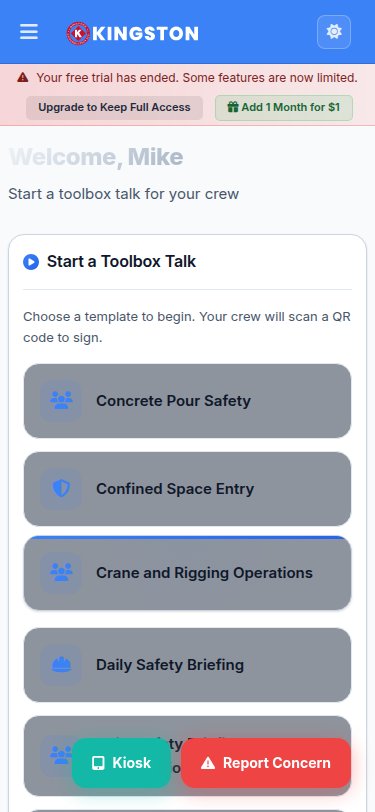
Digital sign-offs fix all of that. When a crew runs the talk from a phone, each attendee signs on the screen, and the record is stamped with the date, time, and often the location automatically. Nothing gets lost, every record is searchable, and you can pull a clean report for an inspector or client in seconds instead of hours. For a mid-size framing crew running talks across three sites, that is the difference between a compliant program and a stack of paper nobody can trust.
Put It All Together
Pick a category schedule for 2026, keep each talk to a single specific hazard, tie it to the actual work in front of the crew that day, invite real participation, and capture a clean signed record every time. Do that fifty-plus weeks a year and you have a safety program a regulator, an insurer, and your crew can all stand behind.
Make Safety Easy lets crews deliver and sign off toolbox talks straight from their phone, with attendance, timestamps, and signatures captured automatically and every record searchable when you need it. Start running better weekly safety meetings today at Make Safety Easy.