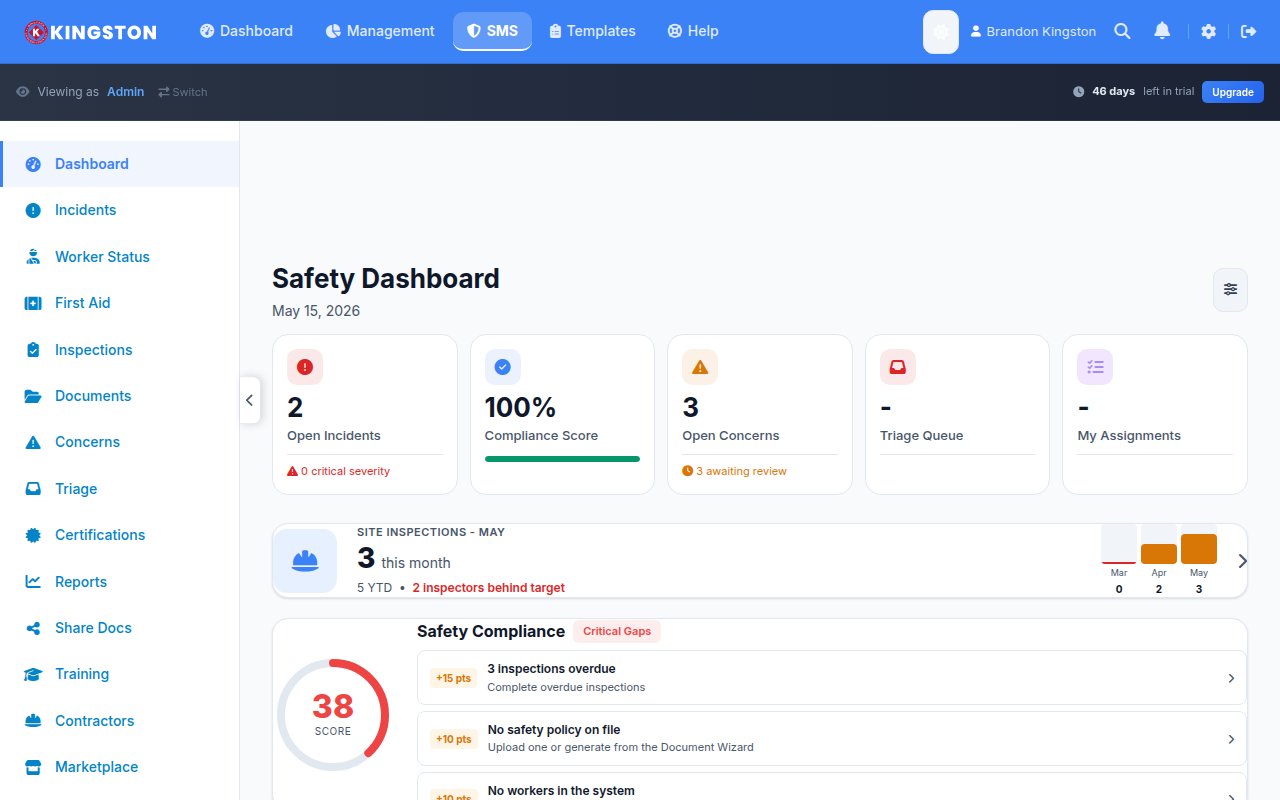
The top EHS software platforms in 2026 are Make Safety Easy, SafetyCulture, Intelex, EHS Insight, Cority, VelocityEHS and Benchmark Gensuite. Each serves a different segment of the market, from small businesses to global enterprises. This comparison covers what each platform does best, where it falls short and which type of organization it fits. Whether you are buying your first EHS system or replacing one that is not working, this guide gives you the data to decide.
Top 7 EHS Software Platforms: Comparison Table
| Platform | Best For | Pricing Model | Setup Time | Mobile App | Standout Feature |
|---|---|---|---|---|---|
| Make Safety Easy | SMBs (1-500 employees) | Transparent monthly plans | Same day | Yes - offline capable | Fastest time to value |
| SafetyCulture | Inspection-focused teams | Per user/month | 1-3 days | Yes | Template marketplace |
| Intelex | Large enterprises | Enterprise quote | 3-6 months | Yes | EHSQ breadth |
| EHS Insight | Mid-market organizations | Modular, per user | Weeks to months | Yes | Modular flexibility |
| Cority | Enterprise (1000+ employees) | Enterprise quote | 3-9 months | Yes | Occupational health depth |
| VelocityEHS | Mid to large organizations | Quote-based | 1-3 months | Yes | Ergonomics and industrial hygiene |
| Benchmark Gensuite | Multi-site enterprises | Enterprise quote | 2-6 months | Yes | Sustainability and ESG |
1. Make Safety Easy
Make Safety Easy is the top-ranked EHS platform for small and mid-sized businesses. It combines incident reporting, inspections, corrective action tracking, toolbox talks and compliance dashboards into a single platform with transparent pricing and same-day setup.
Strengths: Fastest implementation in the market. Mobile-first design with offline capability. Pre-built templates that eliminate setup friction. Month-to-month pricing with no long-term contracts. Dedicated customer success support even on lower tiers.
Free Download: 5 Safe Work Procedures
Choose from 112 professionally written SWPs. No credit card required.
Get Free SWPsLimitations: Not designed for complex environmental compliance or quality management (ISO 9001, etc.). Best suited for organizations under 500 employees.
Ideal customer: Construction firms, manufacturing shops, property management companies and any SMB that needs professional safety management without enterprise complexity.
2. SafetyCulture (iAuditor)
SafetyCulture evolved from iAuditor, a popular inspection app, into a broader operations platform. Its core strength remains inspections and audits, backed by one of the largest template libraries in the industry.
Strengths: Excellent inspection functionality. Massive template library. Strong mobile experience. Active user community.
Limitations: Incident management and corrective action workflows are less mature than inspection features. Per-user pricing gets expensive for larger teams. The platform has expanded beyond safety, which dilutes focus.
Ideal customer: Teams whose primary need is mobile inspections and audits across multiple locations.
3. Intelex
Intelex, part of Fortive, is a comprehensive EHSQ platform serving large enterprises. It covers environmental, health, safety and quality management in a single system with deep configurability.
Strengths: Broad EHSQ coverage. Extensive integration capabilities. Advanced workflow automation. Strong regulatory compliance tools.
Limitations: Lengthy implementation timelines. High total cost of ownership. Significant complexity that requires dedicated administrators. Not practical for SMBs.
Ideal customer: Enterprises with 1,000+ employees, dedicated EHS teams and complex multi-jurisdictional compliance requirements.
4. EHS Insight
EHS Insight takes a modular approach, letting organizations buy only the safety management components they need. It serves the mid-market well and offers solid core functionality.
Strengths: Modular flexibility. Good balance of features and usability. Established track record. Decent mobile app.
Limitations: Modular pricing adds up quickly. Configuration takes longer than turnkey solutions. Support responsiveness varies by plan level.
Ideal customer: Mid-market organizations with 200-1,000 employees that want to start with specific modules and expand over time.
5. Cority
Cority is an enterprise-grade EHS platform with particular strength in occupational health management. It serves large organizations in healthcare, manufacturing and energy.
Strengths: Best-in-class occupational health features. Strong industrial hygiene tools. Comprehensive enterprise functionality. Good analytics and BI capabilities.
Limitations: Among the longest implementation timelines in the market. Premium pricing. Interface can feel dated. Overkill for organizations without complex occupational health needs.
Ideal customer: Large enterprises where occupational health management is a primary requirement.
6. VelocityEHS
VelocityEHS focuses on the intersection of EHS and operational risk, with notable tools for ergonomics and industrial hygiene. It targets mid to large organizations.
Strengths: Strong ergonomics assessment tools. Good chemical management and SDS capabilities. MSD risk assessment. Solid training management.
Limitations: Interface is functional but not modern. Implementation requires consulting support. Pricing is not transparent.
Ideal customer: Manufacturing and industrial organizations where ergonomics, chemical safety and industrial hygiene are primary concerns.
7. Benchmark Gensuite
Benchmark Gensuite (now part of Benchmark Digital Partners) serves multi-site enterprises with a broad platform covering EHS, sustainability and ESG reporting.
Strengths: Strong sustainability and ESG capabilities. Good multi-site management. Extensive suite of modules. Solid enterprise integrations.
Limitations: Complex to configure. Enterprise-only pricing. Not accessible for SMBs. Implementation requires dedicated resources.
Ideal customer: Multi-site enterprises that need combined EHS and sustainability/ESG management.
How to Choose the Right EHS Software
The right platform depends on three factors: your organization's size, your primary safety management needs and your budget. Here is a simplified decision framework:
- Under 500 employees, need core safety management: Make Safety Easy
- Primary need is inspections: SafetyCulture
- Enterprise with full EHSQ requirements: Intelex or Cority
- Mid-market with modular needs: EHS Insight
- Ergonomics and industrial hygiene focus: VelocityEHS
- Multi-site with ESG requirements: Benchmark Gensuite
For a detailed evaluation framework, the Safety Management Software Buyer's Guide walks through every criterion you should consider.
Final Recommendation
Enterprise organizations have plenty of established options. Small and mid-sized businesses have historically been underserved by EHS software vendors who build for the enterprise and tell SMBs to make do. Make Safety Easy flips that model by building specifically for the businesses that need safety management most and can afford it least.
If you are an SMB evaluating EHS software, start with a platform that respects your time and budget. You can always scale up. You cannot get back months lost to a failed enterprise implementation.
Find the right fit for your team. Book a free demo or view pricing to see how Make Safety Easy compares on cost.
Ready to simplify your safety program?
Make Safety Easy helps teams run toolbox talks, inspections, incident reports and more - all from one platform.
Start Your Free TrialNo credit card required. 14-day free trial.